
In the summer of 2023, a scientific expedition led by Dr. James Kempton of Oxford University embarked on a grueling journey into the Cyclops Mountains in Papua, Indonesia. The team faced punishing conditions, from earthquakes that forced them to evacuate caves to battling malaria and venomous snakes. While the mission famously captured the first camera-trap footage of Attenborough’s long-beaked echidna in over 60 years, another massive biological discovery almost flew entirely under the radar.
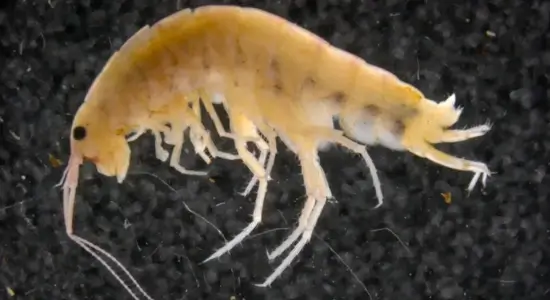
Hundreds of meters up the steep, forested slopes, lead entomologist Dr. Leonidas-Romanos Davranoglou and the team uncovered a bizarre crustacean completely out of its element. This newly discovered tree-dwelling shrimp wasn’t swimming in a remote freshwater pond; it was found actively living in the soil and crawling among the tree branches. Finding a marine-lineage crustacean hopping through the canopy of a tropical rainforest was a total shock to researchers, completely rewriting what we know about how these animals can adapt.
The Biological Reality of a Tree-Dwelling Shrimp
Your standard shrimp relies entirely on gills to extract oxygen from water, which means they are almost exclusively bound to marine or freshwater environments. Finding an entirely new genus of shrimp from a seashore lineage thriving deep inland was an enormous surprise. The researchers quickly realized that the geography of the Cyclops Mountains—a terrain Dr. Kempton described as an enchanting but dangerous “Green Hell”—provided the exact conditions needed for this biological anomaly.
The consistently extreme rainfall and intense humidity trap moisture in the dense forest canopy. This heavy, wet air keeps the creatures damp enough to extract oxygen directly from the environment, completely removing their need to be fully submerged in a body of water.
High-Altitude Acrobats
Measuring slightly larger than a grain of rice, this newly discovered tree-dwelling shrimp has developed serious mechanical upgrades to survive life on land. Because it no longer has the buoyancy of the ocean to escape predators, it relies on heavily modified hind legs. When threatened, the shrimp acts like a coiled biological spring, executing massive jumps to launch itself away from danger. On top of its impressive acrobatics, the females have adapted a safe way to raise their young in the mountains; instead of releasing eggs into ocean currents, they carry them securely in specialized pockets lined along their bodies.
Surviving the “Green Hell”
The 2023 Expedition Cyclops pushed its scientists to their absolute physical limits. The journey was so brutal that Dr. Davranoglou broke his arm in two places, and another crew member had to endure a leech stuck directly to their eye for nearly two days before hospital staff could remove it. Yet, the physical toll paid off exponentially. Alongside the shrimp and the echidna, the team documented a completely unknown goblin-nosed frog and dozens of new insect species, proving that this isolated Indonesian rainforest is a massive engine of evolutionary biology.
Conclusion
The reality of a crustacean leaving the beach behind to live hundreds of meters up a mountain proves how aggressively life will adapt to fill an open ecological slot. As biologists continue to brave the most punishing environments on Earth, we are constantly reminded that our planet’s biology is far stranger and more dynamic than any textbook could predict.
Dive Deeper into More Biological Mysteries…
If a rainforest-crawling crustacean blew your mind, the natural world has plenty of other bizarre anomalies waiting in the dark.
- Did you know researchers recently filmed a bizarre, translucent creature prancing on the ocean floor? Discover why a sea pig was spotted dancing 2,300 meters below the Pacific.
- What happens when a deep-sea animal vanishes from scientific records for over a century? Explore the weird reality of how the faceless cusk eel was rediscovered after 144 years in deep Pacific waters.
Keep exploring the weird and wonderful archives on FactFun.co… because the natural world is always stranger than fiction.
References:
IFLScience — A Tree-Dwelling Shrimp Wasn’t What Scientists Were Expecting To Find When Trekking The Cyclops Mountains
University of Oxford News — Found at last: bizarre, egg-laying mammal finally rediscovered after 60 years Expedition Cyclops — Biodiversity in the Cyclops Mountains