
Most of what people think they know about how fast a T. rex grew up just got rewritten. For years, the standard picture was a dinosaur on a deadline: explosive growth through its teens, full size by around 25, and a life that rarely stretched past 30. A new analysis of growth rings across the largest dataset of T. rex bones ever assembled tells a different story. These animals were often still adding size well into their 40s.
The study, led by Dr. Holly Woodward Ballard of Oklahoma State University and published in the journal PeerJ, didn’t just tweak the old numbers. It challenged the entire method paleontologists had used to read T. rex growth rings in the first place, and along the way, it settled a separate argument that’s been simmering in paleontology for decades.
Reading the History Written in Bone
Aging a dinosaur works a bit like aging a tree. In animals from strongly seasonal climates, leg bones lay down annual growth rings called Lines of Arrested Growth, or LAGs, that mark each year the animal was alive. The catch is that a T. rex’s bones don’t preserve a full record. As the animal grows, the inner core of the bone gets resorbed and remodeled, meaning the earliest 10 to 20 years of growth history are essentially erased by the time the dinosaur dies as an adult.
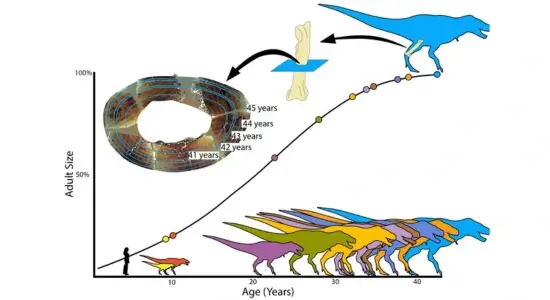 A growth curve analysis of T. rex dimensions relative to age, featuring specific research specimens plotted to illustrate their developmental scale. Image credit: Dr. Holly Woodward Ballard
Earlier studies concluded T. rex growth slowed to a near-stop around age 25. Woodward Ballard’s team went back through the same kind of evidence using cross-polarized light, a technique that reveals extremely faint growth pauses called annuli that are nearly invisible under normal lighting. Those overlooked annuli turned out to matter. Combined with a new statistical method built by Nathan Myhrvold of Intellectual Ventures to stitch together partial growth records from different individuals, the team reconstructed a growth curve extending roughly 15 years further than anyone had previously mapped.
Solving the Nanotyrannus Debate Along the Way
The analysis turned up something else entirely: two of the smaller specimens in the sample didn’t follow the same growth trajectory as the rest at all. Their bone histology pointed to a fundamentally different pattern of development, not just a smaller or younger version of the same animal.
That detail matters because it lines up with a long-running paleontological dispute over whether certain “juvenile T. rex” fossils actually belong to a separate, smaller genus called Nanotyrannus. A separate 2025 study concluded there were at least two distinct Nanotyrannus species, and identified the two growth outliers in Woodward Ballard’s dataset as members of that genus rather than young T. rex. In an addendum to their own paper, Woodward Ballard’s team noted their findings aligned with that conclusion. Confirmation of the discrepancy came from bone tissue, not just skeletal shape, which is a stronger form of evidence than the debate has typically relied on.
Fun Fact
Scientists can tell when a T. rex finished growing in length using a tissue called the external fundamental system, or EFS, which only forms once bone growth in that direction has fully stopped. Woodward Ballard’s team found EFS tissue only in the largest, oldest specimens in their entire dataset, meaning most known T. rex fossils, including several famous museum skeletons, may have died before reaching their true maximum size.
What a Longer Childhood Meant for the Ecosystem
Extending T. rex’s growth period by a decade and a half changes more than a chart. Study co-author Jack Horner, a Presidential Fellow at Chapman University, suggested the animal likely moved through different ecological niches as it aged rather than sprinting toward maximum size as fast as possible, hunting different prey and occupying different roles in its ecosystem at different life stages. That kind of staggered development could be one reason T. rex was able to dominate as an apex predator through the end of the Cretaceous, since young, mid-sized, and fully mature individuals may not have been competing for the exact same resources at the same time.
It also reframes what a specimen like Sue or Scotty, two of the largest T. rex skeletons ever found, actually represents. These weren’t unusually lucky animals that happened to get big fast. They were survivors that outlasted droughts, injuries, and the general hazards of Late Cretaceous life for four decades or more, adding size the entire time.
IFLScience — T. Rex Was Still Growing At 40, Taking A Slower Path To Adulthood Than Previously Thought
Until what age did T. rex keep growing
New research indicates T. rex continued growing until roughly age 40, about 15 years longer than the previous estimate of around 25. Growth slowed significantly in later years but didn’t fully stop until the animal reached its final size.
How do scientists determine a T. rex’s age from its bones
Researchers count Lines of Arrested Growth, annual growth rings preserved in leg bones, similar to counting tree rings. A new technique using cross-polarized light revealed previously overlooked, extremely faint growth pauses that earlier studies missed.
Does this study prove Nanotyrannus was a real separate species
It provides supporting evidence. Two smaller specimens in the dataset showed a fundamentally different growth pattern from typical T. rex, aligning with a separate 2025 study that classified those specimens as a distinct genus, Nanotyrannus, rather than juvenile T. rex.
Did any T. rex fossils actually reach full adult size
Very few. Researchers only found the bone tissue that indicates growth has fully stopped, called the external fundamental system, in the largest and oldest specimens studied. Most known T. rex fossils likely died before reaching their maximum possible size.