
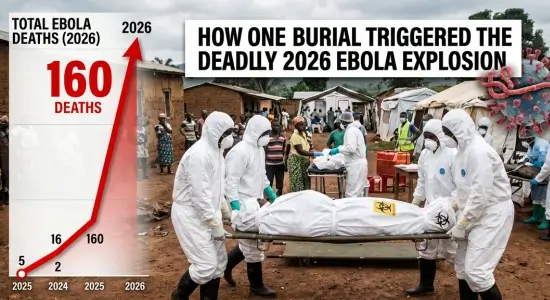
In the Democratic Republic of the Congo, funerals are profound, highly physical expressions of love and community. Families gather to wash, dress, and embrace their departed loved ones before laying them to rest. But on May 5, 2026, in the conflict-heavy region of Ituri Province, this deeply human act of mourning collided with one of nature’s most ruthless microscopic killers. During a large funeral, mourners participated in an open-casket ceremony that involved physically transferring the deceased between coffins. What was meant to be a loving final farewell accidentally became a biological ground zero.
Within weeks of that single gathering, hospital wards across the DRC and neighboring Uganda began filling with patients suffering from massive hemorrhaging and intense fever. Because Ebola does not float through the air like the flu, it relies entirely on direct, physical contact with infectious bodily fluids to find a new host. A human body that has just succumbed to the virus is essentially a biological sponge soaking in billions of infectious viral particles. By touching the deceased, the mourners unknowingly sparked an international health emergency.
Tracing the Origin of the Deadly 2026 Ebola Explosion
When World Health Organization (WHO) epidemiologists, led by emergencies chief Chikwe Ihekweazu, began tracking the transmission chains, all roads led back to that May 5 burial. While the very first suspected death in the region actually occurred on April 20, 2026, it was the funeral weeks later that acted as the ultimate biological catalyst.
When a person dies of Ebola, the viral load in their blood, sweat, and tissues reaches its absolute peak. To the virus, the mourners changing the coffin weren’t just grieving relatives; they were a fleet of fresh, healthy transport vehicles. As attendees left the funeral and traveled back to their homes in densely populated mining regions, they carried the pathogen with them, entirely unaware that they were now highly infectious.
A Terrifying Case of Mistaken Identity
The sheer speed of the outbreak caught the global medical community completely off guard, largely due to a dangerous diagnostic blind spot. When the initial clusters of severe illness appeared in the Mongbwalu Health Zone, doctors immediately ran lab tests looking for the Zaire ebolavirus, the most common culprit behind past African outbreaks. The tests came back completely negative. This gave medical personnel a false sense of security, leading them to assume they were dealing with malaria or a severe, but highly localized, tropical fever.
They were catastrophically wrong. On May 14, advanced laboratory analysis at the National Institute of Biomedical Research in Kinshasa revealed the terrifying truth: the pathogen was the extremely rare Bundibugyo Ebola virus strain. Because the initial rapid tests were mathematically blind to this specific variant, the Bundibugyo Ebola virus strain had been stealthily multiplying and spreading through the community undetected for almost a full month. To make matters worse, unlike the famous Zaire strain, there were absolutely no approved vaccines or specific therapeutics available on Earth to fight it.
The Global Shockwave of a Rare Pathogen
By mid-May, the virus had hitched a ride with travelers fleeing the epicenter, spreading to the DRC capital of Kinshasa and jumping the border into Kampala, Uganda. The virus did not discriminate. Even highly trained medical personnel in full protective gear fell victim, including an American physician named Peter Stafford, who had to be urgently evacuated to a specialized isolation unit in Germany.
Recognizing the horrifying trajectory of the pathogen, WHO Director-General Tedros Adhanom Ghebreyesus took the unprecedented step of declaring the outbreak a Public Health Emergency of International Concern (PHEIC) on May 16, 2026, without even waiting to consult his emergency committee. The sheer speed of the virus, boasting a lethal 40 percent fatality rate, demanded instant global mobilization.
Conclusion
The 2026 Ebola outbreak is a sobering reminder of how microscopic predators seamlessly exploit our best human traits. The virus did not spread across central Africa because of malice or weaponization; it spread through an act of profound cultural compassion. Defeating these biological threats requires more than just advanced laboratory surveillance and rapid response teams. It requires the delicate, often heartbreaking task of asking communities to temporarily abandon the very traditions that make them human, trading the warmth of a final embrace for the cold, sterile safety of a sealed burial.
Explore More Medical Mysteries…
If the terrifying speed of the 2026 Ebola outbreak blew your mind, the history of epidemiology is packed with even stranger, unexplained biological anomalies.
Did you know that in 1962, an entire school in East Africa was forced to shut down because of a highly contagious, uncontrollable fit of giggles? Discover the bizarre mass psychology behind The Disease That Was No Joke: The 1962 Tanganyika Laughter Epidemic.
What if a mysterious pathogen didn’t kill its victims, but permanently froze them inside their own bodies? Uncover the terrifying true story of The Sleep That Didn’t End: How a Ghost Virus Turned 500,000 People into Living Statues.
Keep exploring the weird and wonderful archives on FactFun… because the human body is still science’s greatest mystery.
References:
Reuters — WHO says 139 suspected Ebola deaths in Congo outbreak, numbers expected to rise
CIDRAP — At least 600 Ebola cases suspected as US pledges to fund 50 treatment clinics
World Health Organization — Ebola disease caused by Bundibugyo virus, Democratic Republic of the Congo & Uganda