
In the summer of 1891, Dr. Erwin Hinckley Barbour, a geologist from the University of Nebraska, was exploring the rugged bluffs of Sioux County in the state’s northwest corner. He stumbled upon something that looked like a massive geological prank. Jutting directly out of the sides of the eroded cliffs were perfectly formed spirals of solid rock, some standing over eight feet tall. The locals called them “Devil’s Corkscrews,” and they looked exactly like giant stone screws drilled straight into the earth.
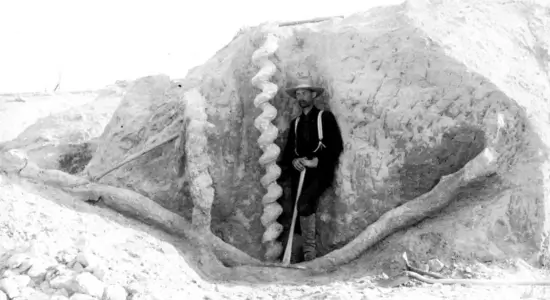
The discovery sparked one of the most intense paleontology debates of the 19th century. Geologists and biologists were completely baffled. Nature rarely creates perfect, massive geometric spirals out of solid sandstone without a biological architect. Initial theories were wild: some argued they were the fossilized remains of giant prehistoric freshwater sponges, while others insisted they were the petrified taproots of enormous extinct vines. It took over a decade of aggressive digging and a shocking skeletal discovery to reveal the true creators, proving that these massive rock formations were actually a feat of prehistoric engineering.
The Great Plant Vs. Animal Debate Over The Devil’s Corkscrews Of Agate
Barbour initially named his discovery Daemonelix (Latin for Devil’s Corkscrew) and published papers arguing they were massive plant fossils. He pointed to plant tissue occasionally found embedded in the outer layers of the sandstone. However, other scientists were highly skeptical. How could a taproot grow in such a perfect, uniform spiral?
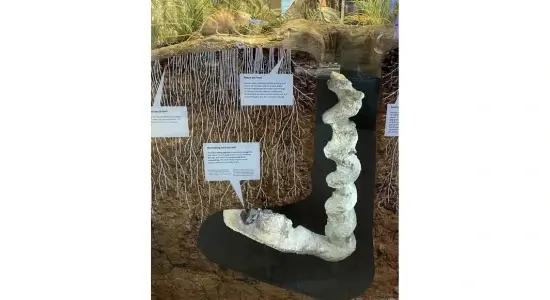
The debate raged until 1904, when a paleontologist named Olaf Peterson traveled to the Agate Fossil Beds to settle the score once and for all. Peterson decided to dig straight down to the base of these towering spirals. At the very bottom of the corkscrew, the spiral flattened out into a horizontal living chamber. Inside that chamber, Peterson didn’t find plant roots; he found a pile of fossilized bones belonging to an extinct, dry-land beaver known as Palaeocastor. The ancient Devil’s Corkscrews of Agate weren’t plants at all—they were petrified underground homes.
How A Beaver Built A 23-Million-Year-Old Spiral Staircase
To understand how an animal made these structures, you have to look at the environment of the Miocene epoch, roughly 23 million years ago. The area that is now Nebraska was a semi-arid, grassy plain, functioning much like the modern African savanna. To survive the extreme temperature swings and hide from roaming predators, the Palaeocastor needed to go underground. Unlike modern beavers that chew down trees to build watery lodges, these ancient rodents were strictly land-dwellers that used their massive front teeth to literally chew through the dry dirt.
They dug their burrows in a tight, helical spiral for a brilliant mechanical reason. A straight vertical drop would be a deadly fall, and a long, gently sloping tunnel would require digging massive distances. A spiral acts like a perfectly engineered staircase, allowing the beaver to easily climb up and down a steep incline while preventing the burrow from easily flooding during heavy rains. When the beavers eventually abandoned their homes, the empty tunnels became geological molds.
Turning Burrows Into Solid Stone
Over millions of years, the abandoned burrows slowly filled with wind-blown sand, silt, and volcanic ash. Mineral-rich groundwater then seeped into these filled tunnels. The silica and calcium in the water acted like a natural cement, binding the loose sand inside the burrow into ultra-hard sandstone. Meanwhile, the surrounding dirt, which made up the original walls of the tunnel, remained much softer.
Fast forward to the modern era, and wind and water erosion slowly stripped away the soft outer soil of the Nebraska badlands. This natural weathering completely exposed the hardened interior casts, leaving the rigid spirals standing upright in the open air. The ancient Devil’s Corkscrews of Agate are simply the 3D-printed ghosts of 23-million-year-old animal architecture, perfectly preserved in stone.
Conclusion
The story of the Daemonelix is a brilliant reminder that the fossil record isn’t just about bones; it is also about behavior. These towering stone spirals provide a perfect snapshot of how prehistoric life engineered solutions to survive in a harsh, changing climate. Today, visitors can still see these massive spirals jutting from the cliffs at Agate Fossil Beds National Monument, standing as a permanent physical record of the hardest-working rodents of the Miocene.
Keep exploring the weird and wonderful.
The story of the Daemonelix is a brilliant reminder that the fossil record isn’t just about bones; it is also about behavior. These towering stone spirals provide a perfect snapshot of how prehistoric life engineered solutions to survive in a harsh, changing climate. Today, visitors can still see these massive spirals jutting from the cliffs at Agate Fossil Beds National Monument, standing as a permanent physical record of the hardest-working rodents of the Miocene.
The universe is always stranger than fiction.
If these stone spirals left you wanting more, our planet has plenty of other baffling phenomena waiting to be explored. Craving more mind-bending science, unsolved mysteries, and unbelievable realities? Dive into the weirdest corners of our world and explore top-tier deep dives and our favorite website for fun facts at Factfun.co
References:
Smithsonian Magazine — The Mystery of the Devil’s Corkscrews
National Park Service — Agate Fossil Beds: The Daemonelix Mystery
IFLScience — In 1891, A Scientist Discovered The “Devil’s Corkscrews Of Agate”. Dating Back 23 Million Years, What On Earth Made Them?