
In early 2026, a research vessel operated by a team of geophysicists from ETH Zurich dropped a fleet of autonomous underwater vehicles (AUVs) into the crushing depths of the Pacific Ocean. Their mission was part of the “Sunken Worlds” initiative, a project designed to map the unlit, unexplored expanses of the seafloor in high-definition. But when the sonar data bounced back from the abyssal plain, the researchers stared at their monitors in shock.
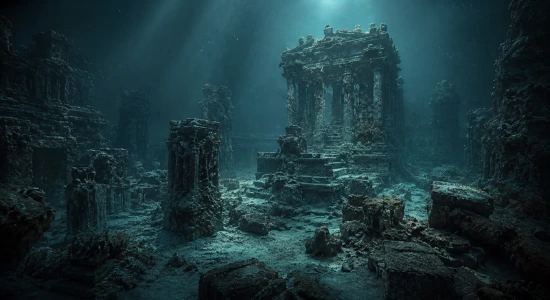
Rising off the ocean floor near the Clarion-Clipperton Zone was a massive, incredibly geometric structure. It featured sheer, perfectly straight walls, right angles, and stepping-stone terraces that looked exactly as though they had been carved by intelligent hands. Instantly dubbed the “Pre-Human Object” by internet sleuths, the anomalous sonar imagery sparked wild, viral theories about ancient sunken civilizations and extraterrestrial deep-sea bases. However, the true geological and physical reality of what ETH Zurich discovered is far stranger—and infinitely more fascinating—than any sci-fi conspiracy.
The Geometric Illusion Of The Pre-Human Object
To understand why this structure looks so suspiciously artificial, you have to look at how we actually “see” the bottom of the ocean. Light doesn’t penetrate that deep, so scientists map the seafloor using multibeam echosounders. These devices send pulses of sound down into the water and measure how long it takes for the echo to bounce back.
The structure in question spans roughly three miles across and rises sharply from the muddy seabed. It possesses a grid-like network of fractures that intersect at seemingly perfect 90-degree angles, creating what looks like the foundation of a ruined, blocky metropolis. When scientists processed the acoustic data from the ETH Zurich 2026 Pacific scan, they realized they weren’t looking at an ancient city. They were looking at an extremely rare, macro-scale demonstration of physics called orthogonal jointing.
How Nature Builds Perfect Right Angles
We tend to think of nature as chaotic—full of curved coastlines and jagged, unpredictable mountains. So, how does the Earth accidentally build something that looks like an ancient pyramid? The answer comes down to thermodynamics and the intense stretching of the Earth’s crust.
Millions of years ago, before humans even existed as a species, this section of the Pacific tectonic plate was flooded with superheated magma. As this massive sheet of volcanic rock slowly cooled in the freezing depths of the ocean, it contracted. When rock shrinks, it has to crack to relieve the physical stress. Because the cooling and stretching happened uniformly across a massive flat plain, the rock fractured in a highly predictable, geometric grid—breaking at near-perfect 90-degree and 120-degree angles. It is the exact same geological mechanism that created the famous hexagonal pillars of the Giant’s Causeway in Northern Ireland, just scaled up to the size of a mountain range at the bottom of the Pacific.
The Biological Reality Of The “Sunken World”
Beyond just providing an incredibly cool lesson in deep-sea thermodynamics, this massive geometric anomaly serves a vital biological function. The abyssal plain is largely a flat, muddy desert where food is scarce. However, a massive rock structure jutting up from the ocean floor aggressively alters deep-sea currents.
The ETH Zurich 2026 Pacific scan revealed that this sharp geological formation creates intense vertical water upwellings, dragging nutrient-rich water from the deep ocean floor up its sheer rock walls. Because of this, the “Pre-Human Object” acts as a thriving biological oasis. Its terraced, step-like ridges are heavily populated by rare cold-water corals, massive sponge gardens, and deep-sea predators that rely on the geometric rock faces to anchor themselves against the rushing currents.
Conclusion
The discovery made by the ETH Zurich team is a brilliant reminder that the Earth doesn’t need ancient aliens or lost human civilizations to build mind-blowing structures. Time, pressure, and the rigid laws of physics are the ultimate architects. The “Pre-Human Object” isn’t a ruined city; it is a stunning, natural monument to the raw volcanic power that shaped our planet millions of years before we arrived to point a sonar beam at it.
Did you know the ocean floor is hiding even more bizarre secrets?
If the geometric illusion of the Pre-Human Object blew your mind, wait until you see the baffling sonar scans of the ‘Millennium Falcon’ hidden in the Baltic Sea. But exploring the abyss isn’t just about solving mysteries—humanity is actively changing it. Discover the shocking biological truth of what a 44-year deep-sea mining experiment just revealed about the fragile ecosystems thriving in the dark. Dive deeper and keep exploring our sunken worlds!
References:
Scientific American — The Physics of Columnar Jointing and Orthogonal Fractures
Nature Geoscience — High-Resolution Sonar Mapping of Abyssal Plain Topography
Oceanography — Deep-Sea Oases: How Seamounts and Canyons Drive Ocean Biodiversity