
In late January 1959, a group of nine highly experienced mountaineers, led by a 23-year-old engineering student named Igor Dyatlov, embarked on a grueling ski trek through the northern Ural Mountains of the Soviet Union. Their destination was Mount Otorten, a route classified as Category III—the most difficult and dangerous level for winter alpine hiking. But they never made it. Weeks later, when a search and rescue team finally tracked down their snow-covered campsite on the eastern slope of Kholat Syakhl (a name that translates to “Dead Mountain” in the local Mansi language), what they found defied all logic and human survival instincts.
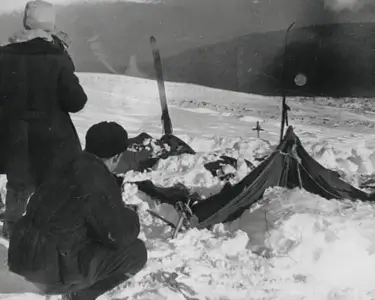
The hikers’ tent was half-buried in the snow, slashed open from the inside. All of their heavy cold-weather gear, including boots, gloves, and thick coats, had been left behind. Footprints leading away from the tent showed the team had fled in a panic into the freezing night wearing nothing but socks, or in some cases, completely barefoot. The temperature outside was an unforgiving -30°C (-22°F). When Soviet investigators finally recovered the bodies scattered across the snowy terrain, the bizarre state of their remains birthed a decades-long debate over what happened at Dyatlov Pass. While some simply froze to death, others suffered massive internal chest trauma, crushed skulls, and unexplainable soft tissue damage.
The Bizarre Condition of the Bodies in The Dyatlov Pass Incident
The first bodies discovered by searchers in February 1959 were found under a large cedar tree at the edge of a forest, about 1.5 kilometers away from the tent. Yuri Krivonischenko and Yuri Doroshenko were found dead in only their underwear, lying next to the remains of a small, desperate campfire. The branches of the cedar tree were snapped up to five meters high, suggesting someone had climbed it to look back at the tent—or to escape something on the ground. Nearby, the frozen bodies of Igor Dyatlov, Zinaida Kolmogorova, and Rustem Slobodin were found spaced out in a line, posed as if they had been desperately trying to crawl back up the slope to their camp.
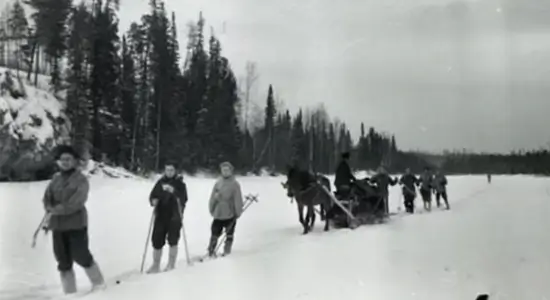
The true horror, however, wasn’t uncovered until May 1959, when the spring thaw revealed the remaining four hikers buried beneath four meters of snow in a deep ravine. Lyudmila Dubinina, Semyon Zolotaryov, Alexander Kolevatov, and Nikolai Thibeaux-Brignolles had sustained catastrophic, fatal injuries. Zolotaryov and Dubinina had completely crushed chests, while Thibeaux-Brignolles had a fractured skull. The medical examiner at the time noted that the force required to cause such internal damage was equivalent to being struck by a speeding car, yet there was remarkably little external bruising. Even more disturbing, Dubinina was missing her tongue, eyes, and parts of her facial tissue.
The Physics of a Delayed Avalanche
For decades, the lack of an obvious avalanche debris field led conspiracy theorists to blame everything from Soviet weapons testing to the Yeti for what happened at Dyatlov Pass. However, in 2021, two researchers based in Switzerland, Johan Gaume and Alexander Puzrin, published a groundbreaking study detailing a rare phenomenon known as a “delayed slab avalanche.”
Think of a slab avalanche not as a fluffy wave of powdery snow, but like a rigid, heavy sheet of drywall sliding off a slanted roof. When the hikers dug a cut into the snowpack to pitch their tent on February 1, they unknowingly destabilized the foundation. Hours later, violent katabatic winds—heavy, freezing air plummeting down the mountain—pushed more snow onto the slope above them. Eventually, a massive block of dense, ice-hardened snow slipped and slammed directly into the tent. This explains the blunt force trauma: the hikers sleeping on their backs were crushed instantly by the immense weight, causing the car-crash-like chest and skull fractures without breaking the skin.
Paradoxical Undressing and the Biology of Freezing
If an avalanche struck, why were they mostly naked? The answer lies in the terrifying biology of severe hypothermia. When the human body is exposed to extreme freezing conditions, it restricts blood flow to the extremities to keep the core organs warm. However, in the final stages of hypothermia, the muscles controlling these blood vessels become completely exhausted and fail.
When this happens, warm blood rushes back into the skin all at once. The victim experiences a sudden, burning sensation, making them feel as though they are literally on fire. This leads to a well-documented medical phenomenon known as “paradoxical undressing,” where freezing victims tear off their clothes in a confused, delirious state right before death. As for the missing eyes and tongue of Lyudmila Dubinina? The ravine where she was found had a small stream running beneath the snow. Over the course of three months, natural decomposition in a wet environment, combined with small scavenging animals, easily explains the missing soft tissues.
A Tragic Reality
In 1959, Soviet authorities abruptly closed the criminal investigation, concluding that a “compelling natural force” had caused the deaths. This vague phrasing fueled over sixty years of wild speculation. While secret military tests and supernatural entities make for fantastic internet lore, the reality of the Dyatlov Pass is a sobering reminder of nature’s indifference. It was a tragic, perfect storm of a rare mechanical snow failure, extreme alpine weather, and the brutal physiological breakdown of the human body under unimaginable duress.
Did You Know? The Brain’s Strange Freezing Instinct
The terrifying “paradoxical undressing” that helps explain what happened at Dyatlov Pass isn’t a rare anomaly. Forensic studies show that in roughly 25% of all fatal hypothermia cases, victims are found partially or completely naked. Even stranger, just moments before death, the failing brain often triggers a primal, evolutionary response called “terminal burrowing.” This forces freezing victims to desperately dig themselves into small, tight spaces—under logs, deep snowdrifts, or even furniture—acting on an ancient survival instinct to hibernate when the body realizes it is shutting down.
If you are fascinated by the terrifying ways the human body can break down, discover how a ghost virus turned 500,000 people into living statues. Or, if you prefer chilling mysteries that science still struggles to explain, dive into the unsettling true story of the Smurl haunting.
References:
- National Geographic — Has science solved one of history’s greatest adventure mysteries?
- Nature (Communications Earth & Environment) — Mechanisms of slab avalanche release and impact in the Dyatlov Pass incident
- Smithsonian Magazine — New Study Explains the Dyatlov Pass Incident