
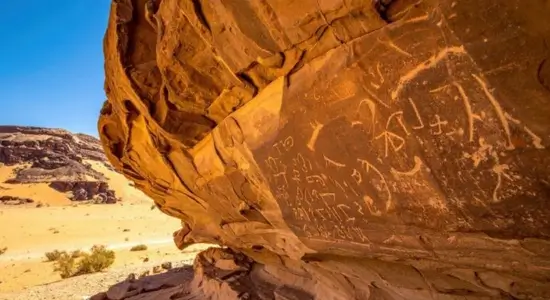
 The rock shelter on the Umm Arak Plateau in Egypt’s South Sinai Desert, holding roughly 10,000 years of continuous human art.
Some walls get repainted every decade. This one got repainted for ten thousand years straight. In Egypt’s South Sinai Desert, a local resident guided archaeologists to a sandstone shelter that turned out to hold one of the longest unbroken records of human art-making ever found on a single rock face, stretching from Stone Age hunters all the way to medieval travelers scratching their names into the same stone.
Table of Contents
A Local Guide, an Overlooked Plateau
The discovery was announced by Egypt’s Ministry of Tourism and Antiquities in February 2026, credited to an archaeological survey team working on the Umm Arak Plateau in South Sinai. They didn’t stumble onto the site by accident, a local resident named Sheikh Rabie Barakat guided the Egyptologists directly to it, the kind of local knowledge that often matters as much as excavation technique in remote desert terrain.
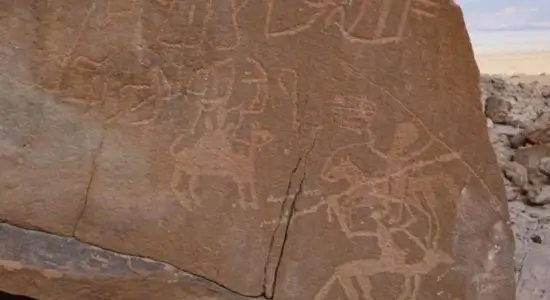 The sandstone shelter stretches roughly 330 feet long, with inscriptions and engravings layered across its surface from different eras.
What they found was a rock shelter roughly 330 feet long, 10 feet deep, with a ceiling reaching up to 5 feet high, modest dimensions for what turned out to be an extraordinarily long-used space. Secretary-General of the Supreme Council of Antiquities Hisham El-Leithy described it as a natural open-air museum, and the description holds up: the shelter’s surfaces record human presence in this exact spot for roughly ten millennia, well before the first pharaoh ever wore a crown.
The Oldest Scene: A Hunter and His Dogs
Near the shelter’s entrance, researchers identified the oldest layer of art, dated stylistically to somewhere between 10,000 and 5,500 BCE. It depicts a hunter holding a bow, accompanied by at least two hunting dogs, alongside ibex, the wild goats that would have been a primary food source in this landscape. The scene predates pharaonic Egypt, which began around 3100 BCE, by thousands of years, meaning whoever painted it was working in a Sinai that looked nothing like the one that would later fascinate Egyptologists.
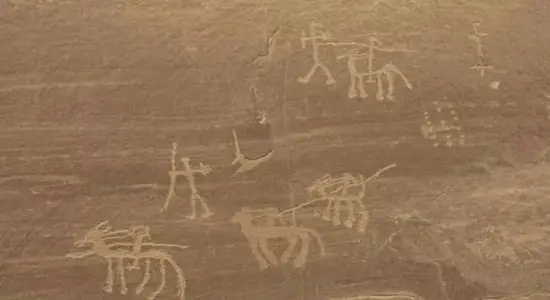 Later engravings at the site show riders and hunting scenes added long after the shelter’s oldest layer of art.
Fun Fact
The rock art includes purely geometric imagery too, X shapes, squares, ovals, and crescents, mixed in among the figurative scenes. Researchers are still working out whether these were decorative, symbolic, or something closer to territorial or ritual markers, since similar geometric motifs turn up at rock art sites across multiple unrelated ancient cultures.
Ten Thousand Years of Additions
What makes this shelter unusual isn’t just its oldest layer, it’s that people kept coming back to add to it for millennia afterward. Later scenes show riders on horseback and figures carrying weapons, reflecting periods well after domesticated horses arrived in the region. Inscriptions in the shelter include Nabataean script, tied to the same civilization that built the city of Petra in Jordan between roughly 400 BCE and 200 CE, alongside markings that Yale University Egyptology professor John Darnell, who wasn’t involved in the discovery, dated stylistically to somewhere between 500 and 1500 CE, spanning late antiquity through the medieval period.
Darnell, who has conducted extensive independent research across the Sinai, pointed out why this particular stretch of desert attracted so much sustained human attention. The Sinai was, in his words, an important region for ancient Egypt, a source of mineral wealth and a symbolically significant one, associated with the goddess Hathor, known as the “Mistress of Turquoise.” The shelter sits close to ancient copper and turquoise mines, and researchers believe it likely served across the ages as a lookout point and a place for travelers to gather and rest, which would explain why so many different groups, separated by thousands of years, chose to leave their mark on the exact same wall.
A single surface holding ten thousand years of continuous human activity is the kind of find that keeps forcing historians to revise the timeline. The Antikythera Mechanism, recovered from a 2,000-year-old shipwreck, did something similar for how advanced ancient Greek engineering really was.
The pattern isn’t unique to famous artifacts either. In Britain, the Iron Age hoard found in Melsonby upended assumptions about how wealthy northern tribes were two millennia ago, and even a piece of everyday Babylonian schoolwork, the 4,000-year-old clay tablet showing a graded math mistake, shows how much ordinary detail about ancient life survives when the right object, or in this case the right rock face, happens to last.
Why This Particular Rock Face
The shelter’s location explains its longevity as a canvas better than any single culture’s intentions do. Sitting near valuable mineral deposits and functioning as a natural waypoint through difficult desert terrain, it would have seen a steady trickle of travelers across every era, hunters, miners, traders, and pilgrims alike, each with a reason to pass through and, apparently, a reason to leave something behind.
The archaeological team is still analyzing the full range of designs, and Darnell has said he’s particularly looking forward to seeing more detailed images of the earliest layers. For now, the shelter stands as a rare kind of historical document: not a single moment frozen in time, but a running record of who passed through one small corner of the Sinai across ten thousand years, written directly onto the stone itself.
This is one of five discoveries featured in 10,000-Year-Old Discoveries That Rewrote History in 2026, covering finds from Turkey, Siberia, the Pyrenees, and the melting ice near Yellowstone.
Live Science — Ancient Rock Art Depicting Hunters and Geometric Shapes Discovered in Egypt’s Sinai Desert
Professor John Darnell, Yale University — Independent Commentary on Sinai Rock Art Dating
How old is the rock art found in the Sinai Desert
The oldest layer of rock art dates to between roughly 10,000 and 5,500 BCE, based on stylistic analysis. The same shelter contains additional art and inscriptions added continuously through medieval times, spanning approximately 10,000 years of use.
What does the oldest rock art in the Sinai shelter depict
The earliest scene, located near the shelter’s entrance, shows a hunter holding a bow accompanied by at least two hunting dogs, along with depictions of ibex, reflecting the hunting practices of prehistoric inhabitants of the region.
Where exactly was the Sinai rock shelter discovered
The shelter is located on the Umm Arak Plateau in Egypt’s South Sinai Desert, near ancient copper and turquoise mining sites. It was found with guidance from local resident Sheikh Rabie Barakat during a survey by Egyptian archaeologists.
Why did so many different cultures add art to the same shelter
The shelter’s location near valuable mineral deposits and along a natural desert route meant it was likely used repeatedly over thousands of years as a lookout point and resting place, attracting hunters, miners, traders, and travelers from many different eras and cultures.