
A forest doesn’t just disappear. It gets buried, burned, or drowned, and it leaves a scar. So when scientists found more than 30 dead pine trees standing on a treeless, windswept plateau above Yellowstone, with no scar, no explanation, and no reason for a forest to have ever existed there, the obvious question wasn’t how they died. It was how they’d been sitting there, perfectly intact, for almost 6,000 years.
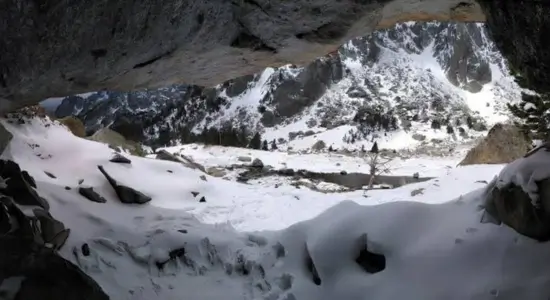
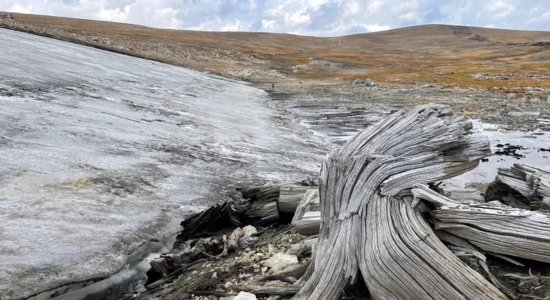 The Beartooth Plateau, just outside Yellowstone’s northeast corner, where retreating ice is exposing a forest that vanished thousands of years ago.
 Table of Contents
A Forest That Shouldn’t Exist, Sitting in Plain Sight
The discovery belongs to a research team led by paleoecologist Dave McWethy of Montana State University, published in the Proceedings of the National Academy of Sciences. On the Beartooth Plateau, a barren stretch of rock just outside Yellowstone’s northeast corner, the team found more than 30 whitebark pine stumps preserved inside a retreating ice patch, standing over 500 feet above the highest living whitebark pines anywhere nearby.
That gap matters. Whitebark pine is already one of the highest-elevation trees in North America, clinging to the harshest ground anything can survive on. For a mature forest to have grown 500 feet above even that extreme, the plateau would have needed a climate warm enough, and wet enough, to sustain trees where today there’s nothing but wind and stone. Tree rings pulled from the stumps show some individual trees lived past 500 years old before the ice quietly closed over them.
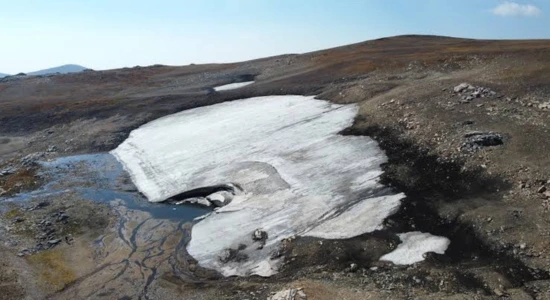 Archaeologists and paleoecologists working the Yellowstone region are racing to document artifacts before the ice that preserved them disappears for good.
Ice Older Than Any Ice Age You’ve Heard Of
Here’s the part that surprised even the researchers who found it. The ice encasing the forest dates to between 5,440 and 5,950 years old, but it isn’t left over from the last Ice Age. It’s far too young for that. Instead, scientists believe this ice, and other patches like it across the Beartooth Plateau, formed around 12,000 years ago, right after Wyoming’s last glacial period briefly gave way to a warmer stretch of climate. Some of it has survived, uninterrupted, for over 10,000 years.
“It was quite a surprise that these ice patches have been around that long,” McWethy said. “We thought they were snowfields at first.” That distinction matters more than it sounds. A snowfield melts and reforms every year. What McWethy’s team found instead was ice that has quietly, continuously existed since before the pyramids, before writing, before agriculture reached most of the planet, sitting exposed at the edge of one of the most visited national parks on Earth, mistaken for ordinary snow.
Fun Fact
Researchers still haven’t found any ice on the Beartooth Plateau older than 10,000 years, and they don’t expect to. The last Ice Age glaciers finished melting around 12,000 to 14,000 years ago, the same window when North America’s megafauna went extinct, so there was simply no ice around to trap a woolly mammoth in, even though their fossils turn up elsewhere in Wyoming.
The Weapon That Was Already Waiting There
The forest wasn’t the only thing the ice had been holding onto. Buried in the same patches, researchers recovered an atlatl shaft, a wooden dart-throwing weapon used by Paleoindian hunters, dated to over 10,000 years old. Wood that old should have rotted away millennia ago. It survived only because the ice sealed it off from air, moisture, and time itself the moment it was lost or discarded.
It wasn’t alone. Bison and bighorn sheep skulls have also turned up in the melt, some showing signs of having been hunted and butchered. Put together, the forest, the weapon, and the animal remains describe the same high, cold plateau serving as an active hunting ground for thousands of years, long before anyone assumed people were capable of surviving up there at all.
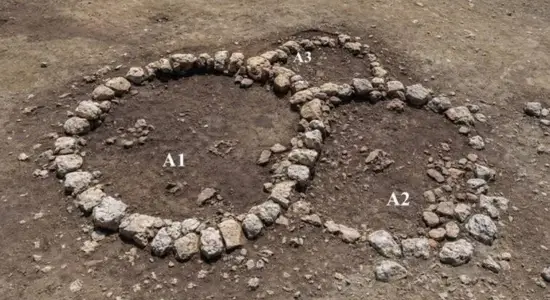
Melting ice isn’t the only thing forcing archaeologists to rewrite old assumptions this year. In southeastern Türkiye, Şika Rika 5 shows people living in permanent settlements up to 2,000 years before agriculture existed in the region, flipping the usual farming-first story on its head.
High in Spain, a radiocarbon database from the Pyrenees revealed humans repeatedly resettled the same high-altitude rock shelters for over 10,000 years, echoing the same pattern now showing up in the Beartooth ice.
Why This Changes the Story of Who Lived Here
For years, the Greater Yellowstone Ecosystem’s high country was treated as background scenery, too cold and too remote for sustained human use. McWethy’s team brought members of the Crow, Eastern Shoshone, and Arapaho nations to see the recovered materials firsthand. Their response cut straight through the assumption: these plateaus were used by their ancestors, consistently, for generations. “The idea that Yellowstone National Park and the surrounding area were devoid of human presence is not accurate,” McWethy said.
The forest and the weapon buried beside it aren’t two separate discoveries. They’re the same story told twice, once by trees that shouldn’t have survived a warm spell 5,000 years ago, and once by a hunting tool that shouldn’t have survived at all. Both were saved by the same accident of geography: ice that never fully let go. As that ice keeps retreating, McWethy’s team already has a list of other patches on the Beartooth Plateau left to check, and after this find, nobody’s betting on them staying empty.
This is one of five discoveries featured in 10,000-Year-Old Discoveries That Rewrote History in 2026, covering finds from Egypt, Siberia, the Pyrenees, and the melting ice near Yellowstone.
Montana State University — Paleoecology Lab, Department of Earth Sciences
Craig Lee, MSU Department of Anthropology and Sociology — Beartooth Plateau Ice Patch Artifact Recovery
What did researchers find on the Beartooth Plateau
Researchers found more than 30 whitebark pine tree stumps preserved in an ice patch between 5,440 and 5,950 years old, along with a 10,000-year-old atlatl hunting weapon and bison and bighorn sheep remains, all exposed as the ice melts.
How old is the ice on the Beartooth Plateau
Some ice patches on the plateau have been dated to roughly 10,000 years old, formed shortly after the last glacial period ended around 12,000 years ago, making them far older than researchers initially assumed when they mistook them for ordinary snowfields.
Why is a 5,000-year-old forest significant
The forest grew over 500 feet above where whitebark pines currently survive, showing the plateau was once warm and wet enough to sustain mature trees for centuries in a spot that is barren and treeless today, offering a preserved record of ancient climate conditions.
Did ancient humans live near Yellowstone’s high country
Yes. The atlatl weapon and butchered animal remains found in the same ice patches show Paleoindian hunters used the high plateau for thousands of years, and Indigenous nations including the Crow, Eastern Shoshone, and Arapaho have confirmed ancestral use of these areas.