
When most people picture a shark, they imagine a sleek, torpedo-shaped predator effortlessly tearing through the open ocean. But if you visit the shallow coastal tide pools of Papua New Guinea, you might encounter a predator that completely ignores the rules of marine biology. During low tide, a small, heavily patterned fish hauls itself out of the water, using its strong pectoral fins like stubby little legs to stroll across the exposed coral. It’s a sight that looks more like a clumsy amphibian than a feared apex predator.
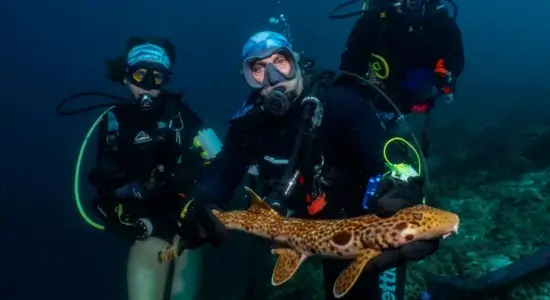
For generations, residents of southeastern Papua New Guinea have known about this peculiar fish, affectionately naming it kadedekedewa, which translates to the “lazy shark” or “dog shark” because of its unhurried, waddling gait. To the global scientific community, however, this creature was completely unknown. That all changed when researchers investigating the reefs of Milne Bay realized this tiny adorable new walking shark wasn’t just a quirky local legend. It was an entirely undocumented species that forces us to rethink how sharks survive in extreme environments.
Finding the New Walking Shark
In March 2025, Christine Dudgeon, an ecologist from Australia’s University of the Sunshine Coast, was swimming through the shallow waters of Milne Bay. She was originally searching for a known species called the leopard epaulette shark. Instead, she stumbled upon a meter-long creature gliding along the seafloor that looked completely different. Rather than the expected leopard spots, this shark’s brown body was covered in stark white dashes and dots resembling braille or morse code.
When she passed the specimen to her colleague, PhD student Jess Blakeway, it became immediately clear they had found something extraordinary. Following extensive genetic analysis, researchers officially introduced the world to Hemiscyllium dudgeonae, or Dudgeon’s walking shark. Published in the Journal of the Ocean Science Foundation in June 2026, this discovery marks the first time since 2013 that a new species has been added to the unique genus of epaulette sharks.
The Mechanics of a “Lazy” Predator
So, why would a shark evolve to drag itself across rocks instead of swimming? The answer lies in the brutal environment of tropical tide pools. When the tide goes out, shallow reef flats transform into dangerously hot, oxygen-depleted puddles that would suffocate a normal fish in minutes. But the tiny adorable new walking shark has developed a stunning biological workaround.
When trapped in a shallow, oxygen-starved pool, H. dudgeonae can voluntarily slow its heart rate and severely restrict blood flow to specific parts of its brain. By essentially putting its body into an ultra-low-power mode, the shark survives extreme hypoxia for hours. More impressively, if its current puddle runs out of invertebrate prey, it simply uses its muscular pectoral fins to heave its body completely out of the water and waddle across the dry reef to a better pool. It can survive entirely exposed to the air for up to two hours, proving that being “lazy” is actually a highly advanced survival tactic.
A Highly Fragile Evolutionary Anomaly
While discovering a new species of shark is incredibly rare, the joy of this find is heavily overshadowed by the reality of its environment. During their expedition, the research team completed 70 separate surveys across the region, leading to a grim realization. H. dudgeonae has the absolute smallest geographic distribution of any known walking shark. Because these animals are physically incapable of swimming across deep water channels, their populations are easily isolated and trapped in tiny, fragmented seascapes.
This extreme isolation makes them uniquely vulnerable. As coastal development, palm-oil plantation runoff, and climate-driven coral bleaching steadily destroy the reefs of Milne Bay, the newly discovered lazy shark has nowhere to run—or walk. Researchers like Blakeway are now racing to gather enough data to have the species officially classified as endangered on the IUCN Red List, hoping that formal protection can save this bizarre evolutionary marvel.
Conclusion
The discovery of Dudgeon’s walking shark is a fascinating reminder that nature doesn’t always favor the biggest, fastest, or deadliest predators. Sometimes, the ultimate key to survival is learning to slow your heart rate, step out of the water, and take a very unhurried walk across the reef. As scientists continue to explore the remote shallows of the world’s oceans, it’s almost certain that more biological rule-breakers are waiting to be found, completely redefining what it means to be a shark.
Dive Deeper into More Biological Mysteries…
If a lazy walking shark blew your mind, the natural world has plenty of other bizarre anomalies waiting to be discovered.
- Did you know researchers climbing a remote Indonesian mountain completely rewrote the rules of marine biology when they found a bizarre tree-dwelling shrimp living high in the rainforest canopy?
- What about a brightly colored ocean micro-predator that is actually smaller than a grain of rice? Uncover the beautiful, alien-like biology of the newly discovered sesame seed sea slug.
Keep exploring the weird and wonderful archives on FactFun.co… because the natural world is always stranger than fiction.
References
Smithsonian Magazine — Scientists Discover a New Species of ‘Walking’ Shark in Papua New Guinea
Journal of the Ocean Science Foundation — Hemiscyllium dudgeonae, a new species of walking shark from Papua New Guinea
IFLScience — Tiny Adorable New Walking Shark Discovered, Dubbed “Lazy Shark” By Locals