
Picture a tsunami. A giant, freezing wall of ocean water, right? Now swap the salt water for 2.3 million gallons of thick, fermenting baking syrup. That’s exactly what hit Boston’s North End shortly after noon on January 15, 1919. A neighborhood full of lunch-break workers and kids got flattened by a wave of molasses.
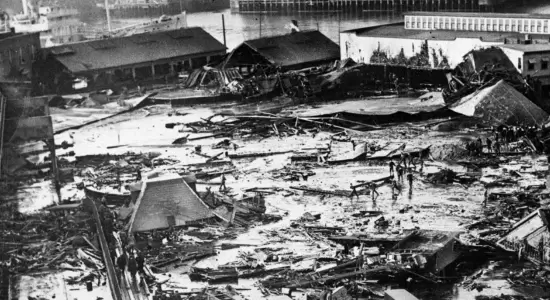
It sounds like a Looney Tunes gag. It wasn’t. A five-story storage tank near Commercial Street ruptured with a boom loud enough that people three blocks away thought a machine gun had gone off. Then the wave came: 25 feet high at its peak, tearing through the street, snapping the elevated train’s steel support beams, and swallowing horses whole. By sunset, 21 people were dead and about 150 injured. What makes the 1919 Boston molasses disaster genuinely strange isn’t just that a neighborhood got wrecked by pancake syrup. It’s the physics of what happens when that much syrup stops being liquid and starts being something closer to cement.
A Rushed Tank and a Company That Painted Over the Problem
So why was a tank holding roughly 2.3 million gallons of molasses, standing 50 feet tall and 90 feet across, sitting in a crowded residential neighborhood in the first place? Blame World War I. Molasses was the cheapest raw material for brewing industrial alcohol, and industrial alcohol was in constant demand for munitions. United States Industrial Alcohol (USIA) wanted in on that money fast, so the company had the tank built in a hurry on Commercial Street. The steel plating was thinner than it should have been, and it showed almost immediately: neighbors reported the tank groaning under pressure, and it leaked syrup often enough that local kids would run over with cups to collect the overflow for free.
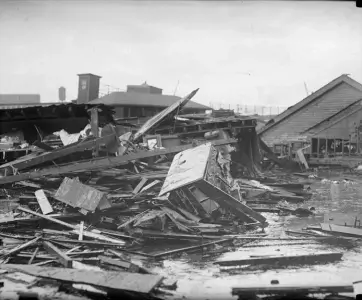
According to accounts collected after the disaster, USIA’s fix for the visible leaking wasn’t structural at all. The company reportedly painted the tank brown, the same shade as molasses, so the seepage would simply blend in rather than get inspected. Whether that’s precisely how the decision unfolded or a detail sharpened by decades of retelling, the tank’s condition wasn’t in doubt. On an unusually mild January day, fermentation gas trapped inside the tank expanded under the warmth, and the already-strained rivets gave way.
Why Molasses Turns Into a Death Trap
When the tank failed, it didn’t produce a puddle. It produced a fluid dynamics case study that researchers at Harvard were still modeling nearly a century later. Molasses is what’s called a non-Newtonian, shear-thinning fluid: the harder it’s pushed, the less resistant it becomes, which is the opposite of how most people expect liquids to behave. Under the explosive pressure of the rupture, the syrup surged out almost like floodwater, fast enough to knock people flat and rip buildings off their foundations.
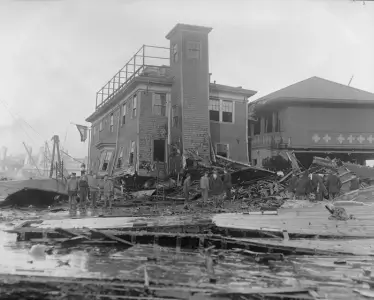
Then came the part that made rescue nearly impossible. As the wave slowed and spread, Boston’s freezing January air went to work. A 2016 fluid dynamics study published by Harvard researchers found that cooling molasses from 10°C down to 0°C roughly triples its viscosity, and the colder it got, the more dramatically that thickening accelerated. Molasses that had surged like water minutes earlier set up almost like wet cement. Victims who tried to swim free only sank deeper, and several rescuers reportedly got stuck to the very people they were trying to pull out.
Fun Fact
The molasses in that tank weighed around 26 million pounds, or roughly 13,000 tons. That’s heavier than the Eiffel Tower, all pressing down on a structure built with steel plating that was too thin for the job from day one.
Cleanup, Court, and a Smell That Wouldn’t Quit
Firefighters tried spraying the wreckage with hoses first. Regular water barely dented it. Crews eventually pumped in cold saltwater straight from the harbor, since only that managed to cut through the hardening sludge enough to search for survivors. It took weeks to recover every body; a few victims were swept off the docks entirely and never resurfaced until the harbor gave them up on its own.
The legal aftermath turned into one of the largest class-action lawsuits Massachusetts had seen up to that point, with roughly 3,000 witnesses called over six years of hearings. USIA lost, and the ruling helped push American cities toward requiring engineers, not just company foremen, to sign off on major industrial construction. Locals have long claimed that on hot, humid summer days for decades afterward, the North End still carried a faint, sickly-sweet smell of old molasses. No lab has ever confirmed that scientifically, but the story has outlived nearly everyone who was there to smell it.
Harvard SEAS / Newswise — Molasses Creates a Sticky Situation: The Fluid Dynamics of the 1919 Boston Molasses Disaster
Boston.gov — 100 Years Ago Today: Molasses Crashes Through Boston’s North End
Massachusetts State House Archives — The Boston Molasses Flood
How many people died in the Boston molasses flood
The disaster killed 21 people and injured roughly 150 more. Many of the deaths were caused by suffocation as thickening molasses trapped victims before rescuers could reach them.
Why did the molasses turn thick and deadly after the tank burst
Molasses is a shear-thinning, non-Newtonian fluid, meaning it flows fast under high pressure but thickens dramatically as it cools. Boston’s freezing January air caused the syrup’s viscosity to spike within minutes, trapping victims like quicksand.
Why was there a giant molasses tank in a Boston neighborhood
United States Industrial Alcohol built the tank to store molasses for brewing industrial alcohol, which was in high demand for munitions production during World War I. The tank was built quickly on Commercial Street, with structural shortcuts that ultimately caused the failure.
Did the smell of molasses really linger in Boston for decades
Longtime North End residents claimed the neighborhood carried a faint molasses smell on hot summer days for decades after the 1919 flood. It’s a well-documented local legend, though no scientific study has confirmed the claim.