
You won’t believe the unexpected discovery that’s been unraveling an ancient mystery! Imagine stumbling upon a hidden tomb filled with mummified crocodiles—yes, you read that right! 🐊
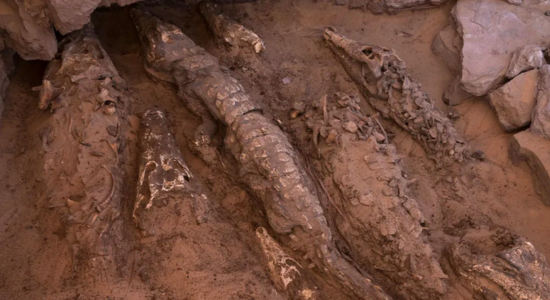
These animals were preserved differently from most mummified crocodiles.
Patri Mora Riudavets under CC-BY 4.0
Back in 2019, archaeologists from the University of Jaén in Spain, working alongside Belgian researchers, were excavating a cluster of small tombs at the Qubbet el Hawa necropolis, just across the Nile from Aswan in southern Egypt. Buried beneath a Byzantine-era rubbish dump—and sitting right next to six other tombs holding local dignitaries—they unearthed a genuinely rare find: a total of 10 mummified crocodiles, including five nearly complete skeletons and five separate heads. Crocodile mummies have turned up in Egyptian tombs before, but discovering this many undisturbed in one single burial chamber is extraordinarily uncommon.
What’s even more fascinating is the unusual way these reptiles were mummified. 🧂 Unlike the classic embalming process most people picture—resin, linen wrapping, organ removal—these crocodiles showed no trace of resin whatsoever. According to the team’s 2023 analysis published in the journal PLOS ONE, it appears these creatures were naturally preserved in the desert heat, likely laid out in dry sandpits where the arid air did all the mummifying work on its own, with no artificial embalming chemicals involved at all.
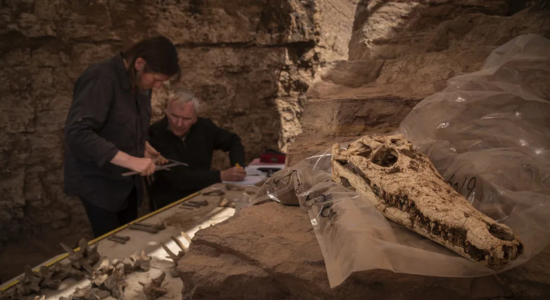
They may have been naturally mummified in sand pits elsewhere before being relocated to Qubbat al-Hawā around the 5th century B.C.E.
Patri Mora Riudavets under CC-BY 4.0
But that’s not all! These crocodiles weren’t just buried for show or convenience. In ancient Egyptian religion, crocodiles were seen as living intermediaries to Sobek, the crocodile-headed god of water, strength, and fertility, whose worship was deeply tied to the life-giving power of the Nile itself. 🐊✨ At Sobek’s major cult centers, like the city the Greeks called Crocodilopolis, crocodiles were sometimes raised specifically to be mummified and presented as sacred offerings once they died, so a burial like this one fits into a much larger religious tradition around the animal. If animal mummification and ancient burial rituals fascinate you, you might also enjoy learning about the Skhul child hybrid discovery, another find from an ancient burial site that’s rewriting what we know about our ancestors.
The crocodiles discovered at Qubbet el Hawa belong to two distinct species: the Nile crocodile (Crocodylus niloticus) and the smaller West African crocodile (Crocodylus suchus, sometimes called the sacred crocodile), with body lengths ranging from about 6 feet up to 11.5 feet (roughly 1.8 to 3.5 meters). The research team found no signs of trauma or violent injury on the remains, but traces of rope near some specimens suggest these animals may have met their end in a rather grim way—tied up and left to die slowly from dehydration, suffocation, or prolonged exposure under the intense Egyptian sun.
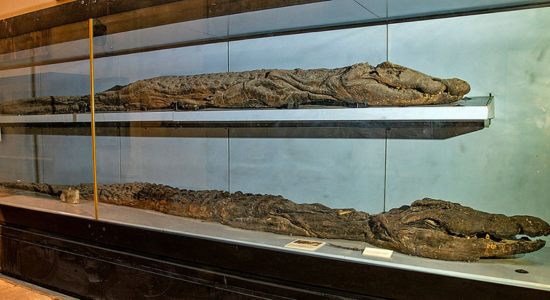
Based on the tomb’s stratigraphy and the complete absence of resin or bitumen in the preservation process, researchers date this burial to the pre-Ptolemaic period, likely sometime before 300 B.C.E., possibly around the 5th century B.C.E. These crocodiles were most likely part of a larger ritual offering to Sobek. And while there’s no evidence of the organ removal typical of classic human mummification, the careful, deliberate way these ancient reptiles were arranged and preserved tells us a great deal about how deeply crocodiles were woven into the cultural and religious fabric of ancient Egyptian life.
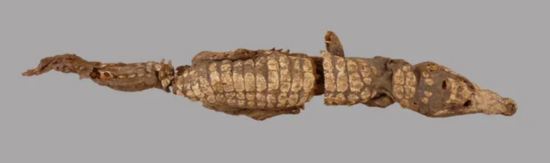
Dorsal view of crocodile number five.
🐊 Fun Fact
Some mummified crocodiles discovered at Sobek’s temples were found with baby crocodiles tucked in their mouths or riding on their backs—a symbolic nod to the god’s role in fertility and the endless cycle of life along the Nile.
If you love fact fun stories, here’s one I think you’ll enjoy!
- Watch the world’s first video of killer whales Hunting Great White Sharks
- Pigbutt worm, a sea worm that looks more like a pig’s butt than a worm
- Extremely Rare All-White Bat Discovered – A First-Ever Case of Leucism in This Species
Can you imagine what it must have been like living among these fierce creatures, revered and feared by ancient Egyptians in equal measure? 🐊 The full story of these mummified crocodiles is still being pieced together, but one thing’s for sure—they were far more than just animals; they were sacred beings caught between the mortal world and the divine.
So the next time you think of crocodiles, remember: these creatures once played a vital role in ancient Egyptian culture, quite literally bridging the world of humans and the gods.
Cr : National Geographic , Smithsonian Magazine , PLOS ONE (original study) , The New York Times